🇺🇿 Uzbekistan · White Wolves
Uzbekistan travelogue: routes, football and local culture
Searching for modern answers on an ancient trade route
The travel story
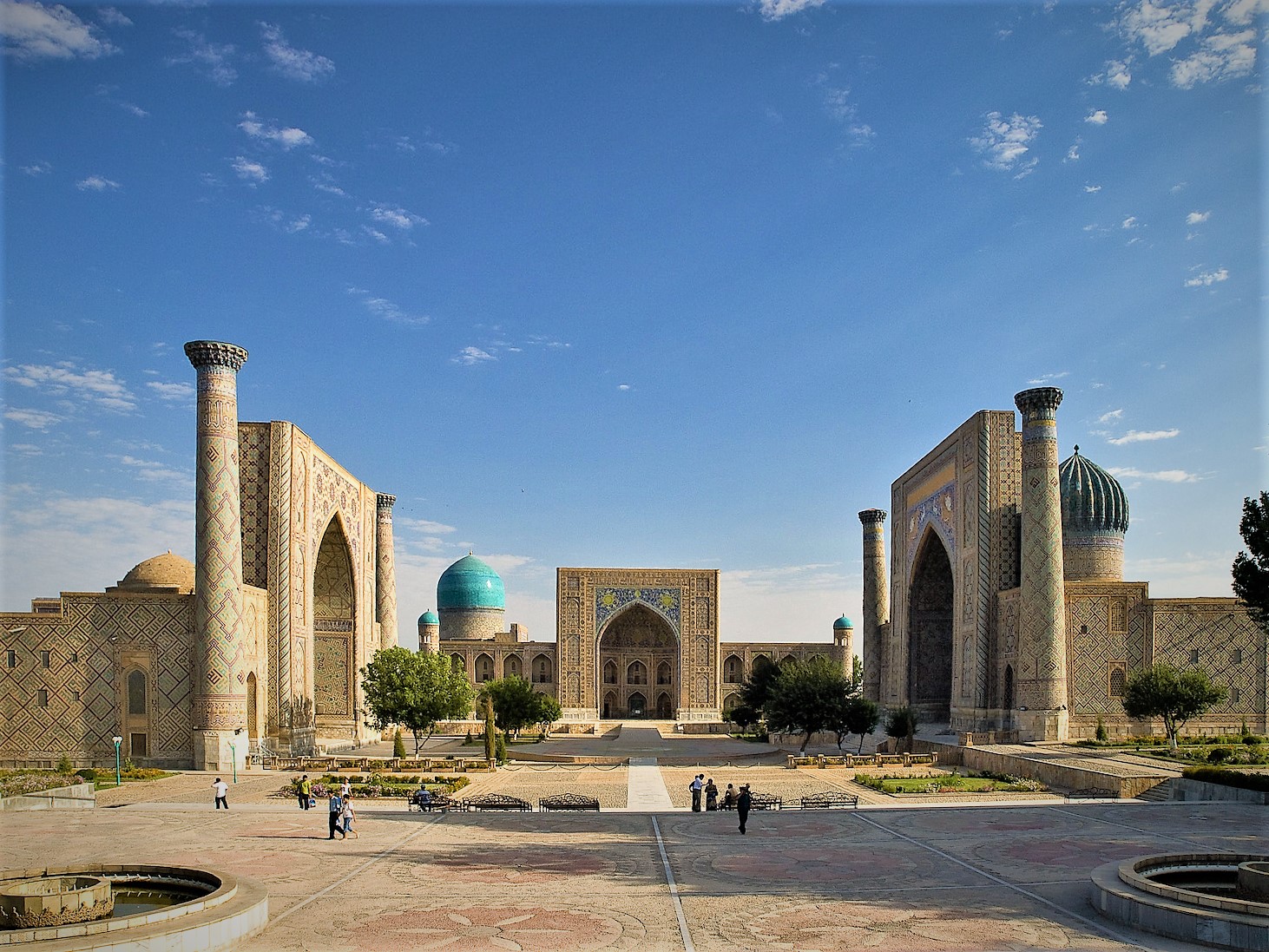
Samarkand's Registan Square at 6:45 in the evening turns into a shade of gold you have never seen before. The blue tiles of the three madrasas wake from the cool geometry of Islam and begin to absorb the dying heat of the sun. An old man selling pomegranate juice told me in halting English: 'This place was a debating ground six hundred years ago — students from all three madrasas arguing in the square. Theology, astronomy, mathematics, anything.' Then he added salt to my cup and said: 'Drink it. Pomegranate juice without sugar — that's how you taste the Silk Road.'
He was right. Unsweetened pomegranate juice has a sharp acidity, like the aftertaste of everything on this land that is fading. And my question was this: what actually remains of the Silk Road?
Uzbekistan has a population of over 36 million, the most populous country in Central Asia, and one of only two doubly landlocked nations on Earth (the other being Liechtenstein). For a country sealed in by land on all sides, the Silk Road is not just history — it is the loudest proof this nation ever had of its existence in the world. In 2026, the White Wolves — Uzbekistan's national team — will appear on the World Cup stage for the first time. For many football fans, this will be the first time they ever search 'where is Uzbekistan.'
Day one belonged to Tashkent. The Tashkent metro is not merely a transit system — it is the strangest legacy the Soviet Union left in Uzbekistan. Every station is an independent artwork: the dome of Alisher Navoi station depicts Central Asian poets in mosaic; the walls of Kosmonavtlar station pay tribute to everyone from Yuri Gagarin to Uzbek cosmonauts. A metro security officer saw my foreign face, raised an eyebrow, and waved me through — locals pay, foreigners free, an unwritten rule of Tashkent.
Day two I was on the high-speed train to Samarkand. Outside the window, the landscape shifted from urban gray to cotton-field white, then to the brown fringe of the Karakum Desert. The young man in the next seat used a translation app to ask where I was from, then proudly showed me a screenshot on his phone: the news that Uzbekistan had qualified for the World Cup. 'Abdukodir Khusanov,' he said, pointing at the twenty-year-old defender on the screen. 'He plays for Lens. In France. Now the French know where Tashkent is.'
Places, routes and match-day culture
Days three and four were Samarkand and Bukhara. Samarkand's blue tiles are deeper than any photograph can convey — that particular blue looks dredged from the floor of the Mediterranean but baked dry under a Central Asian sun. In Bukhara's old city, I got lost for three hours. Not because the city is large, but because every half-open wooden door seemed to lead into another era. A silk merchant sat in his shop — actual silk, brought from the Fergana Valley, dyed red with madder root — and saw me staring at the bolt of red silk for a long time. 'You know,' he said, 'Marco Polo never wrote about this color. He said Uzbek silk was cheap, but he never wrote about the red.'
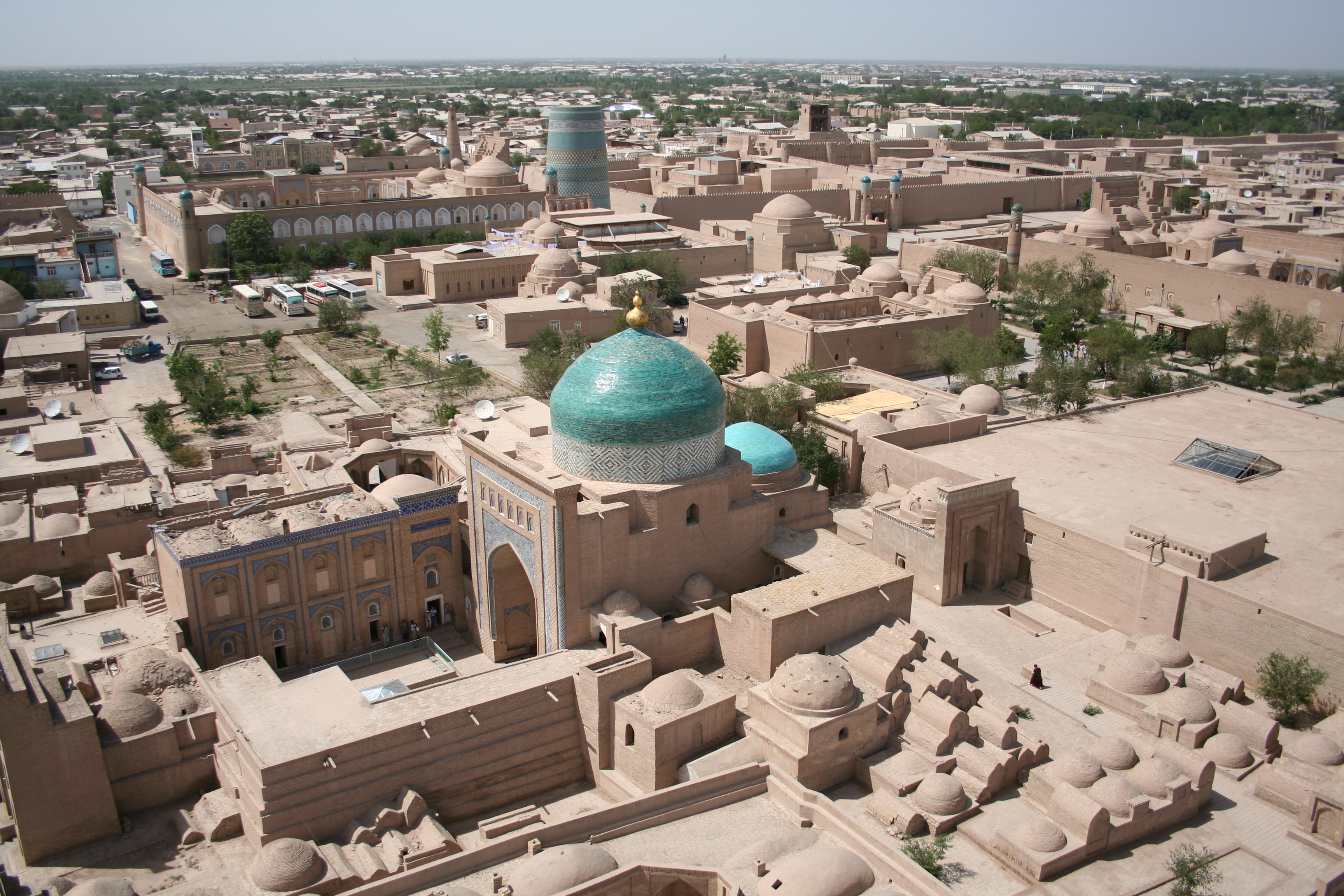
Khiva was day five. This walled oasis city, ringed by ochre fortifications, was nearly empty under the midday sun. I sat in the shadow of the Kalta Minor minaret. An old man ambled over and sat beside me. 'Tourists come at four in the afternoon,' he said. 'Morning is Khiva's own time.' We were silent for a long while. Then he pointed at a distant Uzbek flag fluttering and said: 'You see that football pitch? It used to be a stable. During the Silk Road, merchants changed their horses here. Now young people kick a ball there. What gets swapped has changed, but the road is still the same road.'
Day six unfolded on an overnight train — Khiva back to Tashkent, tracing the desert's edge. The carriage radio crackled with Russian oldies in a Central Asian accent. Outside the window, the occasional camel herd and scattered lights flickered past. I thought about what the silk merchant in Bukhara had said, about the gold of Samarkand, about the raised eyebrow of the metro officer in Tashkent. Then I pulled up Abdukodir Khusanov's Ligue 1 highlights on my phone — a twenty-one-year-old Uzbek kid sliding, chasing, pinging long passes across a French pitch.
Day seven, back in Tashkent. The sun was as dry and hot as it had been a week ago. But what I was carrying home was not photographs or souvenirs — it was the answer to a question. The Silk Road hasn't 'left' anything behind — it just changed its form of existence. Spices became a football economy; caravan stations became high-speed rail stops; silk became player transfer contracts. What Marco Polo left out wasn't just the color of that bolt of red silk — he left out the fact that the people on this road never really leave. They just trade camels for trains, and spices for football.
Route planning
Plan the Uzbekistan route
Before standalone attraction pages are ready, use these decisions to shape the route: lock transport first, place city highlights second, then check practical friction before booking.
Set the transport spine
For a first trip, start with Tashkent -> Samarkand -> Bukhara -> Khiva, then build hotel nights around train and long-distance transfers.
Place highlights by city
Keep Registan Square for Samarkand evening light, walk Bukhara slowly, sleep inside Khiva's walls, and use Tashkent metro on arrival day.
Check before booking
Review entry rules, mobile data, cash, Yandex Go, train tickets, and night transfers before the route becomes fixed.
Discover more countries
Travel stories from other countries
Cape Verde
Entering an Atlantic archipelago through its music
Curacao
One island, two worlds
Jordan
Tracing the entire journey backward from the Treasury's light
Haiti
Returning home through the eyes of a diaspora footballer
DR Congo
City → River → Rainforest → Lava lake
Iraq
Between Mesopotamian ruins and teahouses
Qatar
The real bill for 24 hours in Doha
Netherlands
From Amsterdam's canals to Breda's football ground, water routes and land routes unfold together
Switzerland
A geographical-acoustic travelogue, from Zurich lake mist to the whistle of Jungfrau trains
Morocco
An olfactory-map travelogue, from spice markets to the sweetness of mint tea
South Africa
From the silence of Robben Island to street football in Soweto, seeing how Bafana Bafana kicks the country back into one team
Japan
An immersive five-senses travelogue, from Shibuya's live screens to the sea breeze of Yokohama
Senegal
From Dakar street football and the silence of Goree Island to the salt light of Lac Rose, understanding the Lions of Teranga
Korea
An immersive five-senses travelogue, from street football in Hongdae to dusk in Chuncheon
Ivory Coast
Lagoons, cocoa, and orange shirts.
Norway
A landscape-contrast travelogue, from the edge of the North Sea to the depths of the fjords
Uganda
An immersive five-senses travelogue, from Kampala street football to Bwindi's silverback gorillas
← View all stories · Country travel guide · Browse all downloadable travel maps
Plan with confidence
Uzbekistan travelogue FAQ
What does this Uzbekistan travelogue cover?
It connects Uzbekistan's routes, landscapes, food and football culture with practical next steps in the country guide.
Where can I find practical Uzbekistan travel information?
Use the Uzbekistan travel guide for entry planning, transport, budgets and route ideas, then confirm time-sensitive requirements with official sources.
Is this page a substitute for official travel advice?
No. Entry rules, safety guidance and transport conditions can change; confirm them with official sources before booking.