🇨🇻 Cape Verde · Blue Sharks
Cape Verde travelogue: routes, football and local culture
Entering an Atlantic archipelago through its music
The travel story
The plane touches down at Praia Airport on Santiago Island, and Cape Verde does not greet you with skyscrapers. Outside the window: low brown hills, air dry and transparent. The thing that actually tells you where you've landed comes the moment you step out of the terminal — a sound. An old man sits on a low wall, playing a battered guitar. There is sea salt in the strings; the tuning is imperfect, but the rhythm is right.
Cesária Évora's voice drifts from the taxi's radio. She died in 2011, but in Cape Verde her voice is more punctual than any flight. The driver gestures toward the radio with his chin and says something in Portuguese threaded with Creole — I didn't catch every word, but I caught the pride in it. Morna, he said. Then he turned the volume up.
Cape Verde sits roughly 570 kilometers west of Senegal in the Atlantic, ten volcanic islands, population about 600,000. The country is so small that many world maps don't even mark it. But if you have ever heard morna anywhere — that melancholy melody suspended somewhere between Portuguese fado and Brazilian samba — you know this place cannot be small.
On my first night in Mindelo's harbor, I walked into a bar called Cafe Musica. The walls were papered with a faded Cesária Évora poster, a local football team photo, and a handwritten menu: Cachupa, grilled fish, grogue rum. The singer was a woman in her forties, barefoot, eyes closed. The guitar chord shifted pitch in the humid air, but no one minded. Dockworkers stopped hauling rope and leaned against the sea wall to listen. A child crouched in the doorway watching — at his feet, a faded football.
Places, routes and match-day culture
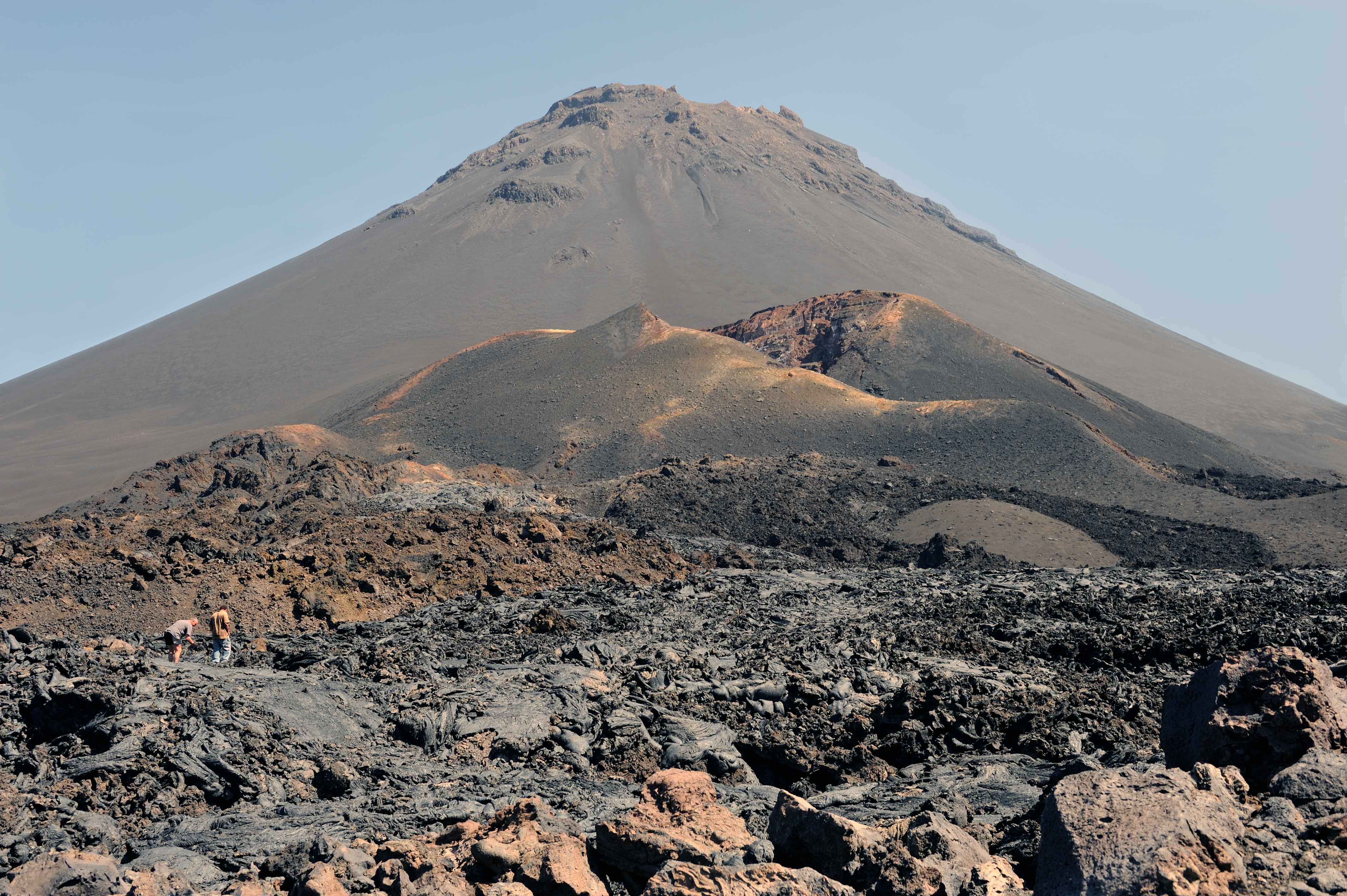
The next day I went to Pico do Fogo. Underfoot: black lava, rough and brittle, the soles of my shoes collecting fine dark grit. The guide said the volcano last erupted in 2014, destroying two villages, but nearly all the villagers came back. 'This is our island,' he said. 'The volcano is a neighbor with a bad temper — but you don't move away just because your neighbor has a temper.' From halfway up, looking out over the Atlantic, I understood for the first time what it means to be an archipelago without an endpoint — as far as the eye could see, nothing but sea and more sea.
On Santa Maria Beach in Sal, children kicked a ball barefoot. The ball was old, its skin worn through, but the way they passed it looked like another kind of morna. One boy's blue shirt bore a faded number on the back — not Messi or Ronaldo, but Ryan Mendes, the Cape Verde national team forward. He pointed at the shirt: 'He was born in Mindelo. Same as us.' Not far away, a Blue Sharks flag fluttered softly above a beach stall.
Food was the final key. Cachupa — a slow stew of corn, beans, vegetables, and fish or meat — had been simmering since six that morning. In the market, women sat on low stools shelling corn at a speed the eye could barely follow. They chatted in Creole, occasionally breaking into laughter. An old woman selling vegetables handed me a small bowl of cachupa, no charge. 'Come, taste,' she said slowly in Portuguese. 'Cape Verde's flavor needs time.' I spent half an hour finishing that bowl, and I understood she was not talking about cooking.
On the morning I left, I returned to Cafe Musica in Mindelo. The bar was not yet open. The sea breeze nudged the old poster on the door. In the distance, a ferry horn sounded in the harbor. An old man walking his dog passed by, saw me looking at the poster of Cesária Évora, and stopped. In English he said: 'You know her most famous line? Sodade — a longing with no specific shape.' Then he walked on. I stood before the empty harbor and suddenly understood the full meaning of morna: Cape Verde is not a country that can be described by a map. It can only be marked by sound, by taste, by sea wind. Like sodade itself — you know it is there, but you cannot say what shape it has.
Discover more countries
Travel stories from other countries
Curacao
One island, two worlds
Uzbekistan
Searching for modern answers on an ancient trade route
Jordan
Tracing the entire journey backward from the Treasury's light
Haiti
Returning home through the eyes of a diaspora footballer
DR Congo
City → River → Rainforest → Lava lake
Iraq
Between Mesopotamian ruins and teahouses
Qatar
The real bill for 24 hours in Doha
Netherlands
From Amsterdam's canals to Breda's football ground, water routes and land routes unfold together
Switzerland
A geographical-acoustic travelogue, from Zurich lake mist to the whistle of Jungfrau trains
Morocco
An olfactory-map travelogue, from spice markets to the sweetness of mint tea
South Africa
From the silence of Robben Island to street football in Soweto, seeing how Bafana Bafana kicks the country back into one team
Japan
An immersive five-senses travelogue, from Shibuya's live screens to the sea breeze of Yokohama
Senegal
From Dakar street football and the silence of Goree Island to the salt light of Lac Rose, understanding the Lions of Teranga
Korea
An immersive five-senses travelogue, from street football in Hongdae to dusk in Chuncheon
Ivory Coast
Lagoons, cocoa, and orange shirts.
Norway
A landscape-contrast travelogue, from the edge of the North Sea to the depths of the fjords
Uganda
An immersive five-senses travelogue, from Kampala street football to Bwindi's silverback gorillas
← View all stories · Country travel guide · Browse all downloadable travel maps
Plan with confidence
Cape Verde travelogue FAQ
What does this Cape Verde travelogue cover?
It connects Cape Verde's routes, landscapes, food and football culture with practical next steps in the country guide.
Where can I find practical Cape Verde travel information?
Use the Cape Verde travel guide for entry planning, transport, budgets and route ideas, then confirm time-sensitive requirements with official sources.
Is this page a substitute for official travel advice?
No. Entry rules, safety guidance and transport conditions can change; confirm them with official sources before booking.